
 WE
WE 

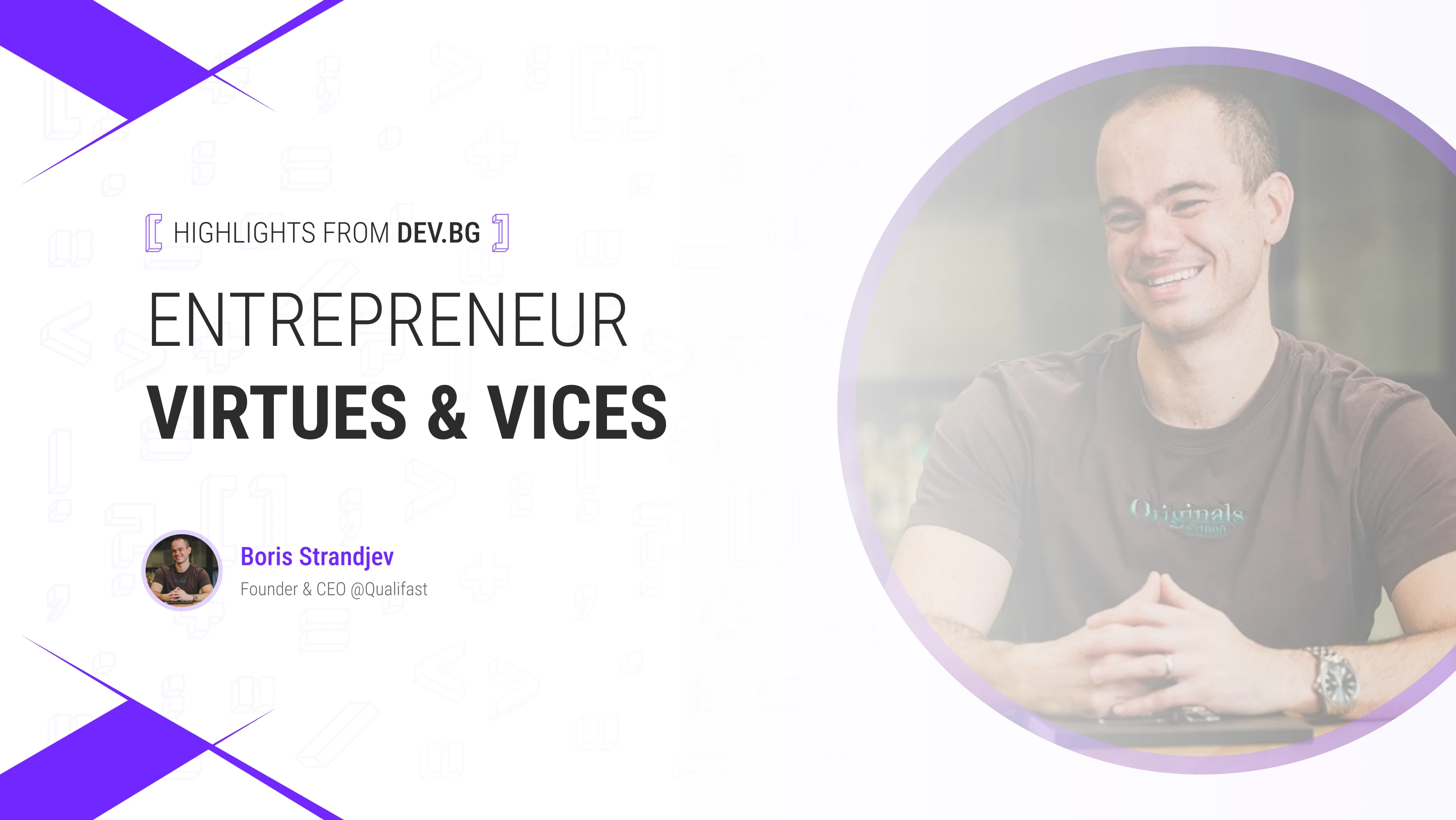
Based on a talk by Boris Strandjev, CEO of Qualifast, at the DEV.BG Entrepreneurs Club
Boris Strandjev has spent the last 15 years building startups, acting as CTO in more than ten of them. That kind of repeat exposure gives you something most founders never get: a pattern library. Not theory, not frameworks borrowed from a business school case study — actual, repeatable failure modes he's watched play out again and again, alongside the habits that reliably pull companies through.
At a recent DEV.BG Entrepreneurs Club session, he shared that library in full, structured around a simple but powerful idea: antipatterns (the things that quietly sabotage startups) and positive patterns (the habits that keep them alive). He built his framework by cross-referencing his own experience against Sim Simeonov's well-known antipattern list, keeping the ones that fit best as the backbone of the talk.
Here's the rundown.
Why Antipatterns Matter
No founder is immune to bad habits. Some people simply lack the experience to recognize a problem forming under their feet; others get pushed into bad decisions by external pressure — investors, deadlines, competitors. As Boris put it, it's worth revisiting lists like this on a regular basis, precisely so you get reminded of your own weaknesses and can catch yourself before they cause damage.
He also pointed to cognitive biases as a root cause worth naming: naive realism, confirmation bias, stereotyping, and optimism bias all show up disguised as "founder instinct."
The Antipatterns
Featuritis — Endlessly bolting "just one more feature" onto the roadmap because the product never feels quite ready to launch. It's a great way to burn through your funding before you ever face the market.
Founderitis — When a founder's ego and need for total control become the bottleneck. Team opinions get suppressed, delegation never happens, and the company simply can't professionalize or scale.
If You Build It, They Will Come — The dangerous assumption that a good enough product sells itself. No distribution plan, no sales motion, no marketing — just hope. It rarely works out.
Overengineering — Building complex, highly robust infrastructure for problems you don't actually have yet, instead of spending that time validating your basic assumptions. Worse, once you've built it, there's often no easy way back.
Boiling the Ocean — Trying to solve one enormous, broad problem all at once instead of nailing a narrow, specific niche first. The result is usually an MVP so complex it's no longer minimal, and an offering so broad it's no longer clear.
Bridge to Nowhere — Chasing bridge funding or runway extensions that hit a milestone but don't actually position the company for a real next round or long-term sustainability.
Arrogance — An inflated belief that the founder knows better than the market, leading to ignored pushback, ignored advisors, and ignored data. One of the most common failure modes in early-stage startups.
Unrealistic Expectations — Setting goals and timelines detached from operational reality, which crushes team morale the moment those benchmarks are inevitably missed. As Boris noted, many founders get into entrepreneurship for the wrong reasons in the first place — and stress always comes from within.
Confusing Activity with Results — Mistaking long hours and packed calendars for actual progress, without ever measuring real business impact.
Warm Bodies — Hiring fast just to inflate headcount and look successful, which usually leaves you with a diluted talent pool and operational chaos instead of real capability.
Demand Generation (too early) — Pouring money into marketing, ads, and PR before the product has found product-market fit. Spending big doesn't fix a leaky funnel.
Random Founders — Assembling a founding team based on convenience or proximity rather than shared values, complementary skills, and genuinely aligned long-term goals.
Outsourcing Your Architecture — Handing your core software design over to an external agency, leaving you with an uninspired tech stack and zero internal technical ownership. Boris noted a new twist on this danger emerging in the AI era.
Confusing Involvement for Commitment — Assuming that highly qualified advisors or partners will suddenly dedicate serious time to your business once a certain milestone is hit.
Bad Team Contract — Leaving equity splits, revenue splits, and role conditions vague "for later" instead of framing them explicitly from day one.
The Product Swarm — Building several ideas simultaneously because each one feels like it takes "just a little effort" (a trap made even easier by AI-assisted "vibe coding" today), which spreads focus so thin that none of them get real traction.
Boris also flagged a longer tail of related antipatterns worth watching for: delayed scaling, premature scaling, "oooh, shiny" distraction, chasing only the next funding round, the one-idea entrepreneur, excessive forward thinking, design by committee, and mentor whiplash.
Finding the Right Balance
For antipatterns you can't fully avoid — like outsourcing parts of your build — Boris offered a practical middle path:
- Pre-screen implementers carefully, based on experience and referrals
- Stay actively engaged in the process yourself
- Keep ownership of your source code and supporting systems
- Require documentation and quality control
- Extend trust gradually, but bring in external advisors for periodic validation
- Be fair in your expectations of what any partner can deliver
The Positive Patterns
Antipatterns aren't the whole story. Boris balanced the talk with the habits that consistently show up in founders who make it through.
Experimentation Mindset — Treating product-building as research: every feature or extension is an experiment that might succeed or fail, and that's fine.
Resilience — Holding onto your vision and continuing to fight through economic downturns, crises, and a lack of support — even when the people closest to you are urging you to quit.
Giving Mentality — Entrepreneurship exposes you to a lot of people who need advice and support. Helping others without expecting anything back turns out to be one of the most fulfilling parts of the job.
Beating Your Internal Demons — Recognizing that you are the highest escalation point in your company, and that means doing things you don't yet feel ready to do.
The Resourceful Opportunist — Being pragmatic and proactive enough to seize the right chances the moment they appear — the trait Boris pointed to as most visible in someone like Elon Musk.
The Takeaway
Boris closed with five points that double as a founder's reality check:
- We all operate inside an antipattern sometimes — the first job is simply noticing it.
- Having an antipattern present isn't a guaranteed sign of failure.
- Having a positive pattern present isn't a guaranteed sign of success either.
- These lists are worth re-reading periodically, not just once.
- Entrepreneurship is constant experimentation — keep your eyes and mind open.
Or, as he put it most memorably: "The good organizations avoid antipatterns. The best violate some."
Boris Strandjev is CEO of Qualifast. You can find him on LinkedIn and GitHub.